Why Backward Sled Drags Build Knees Nothing Else Can
Quick Answer: Walking backward while dragging a sled loads the quads — especially the fibers around the knee — through a motion that is almost purely concentric: muscles shorten under load but never lengthen under it, because the sled slides instead of lowering. No eccentric phase means minimal muscle damage and next-day soreness, which lets you train the quads hard and often without the recovery bill squats charge. That combination — meaningful load, knee-friendly angles, near-zero soreness, high frequency — is why backward drags became the quiet staple of knee rehab and the smartest accessory in strength programs. It is cardio, quad work, and knee therapy sharing one implement.
Here is the mechanism, the programming, and the mistakes that waste it.

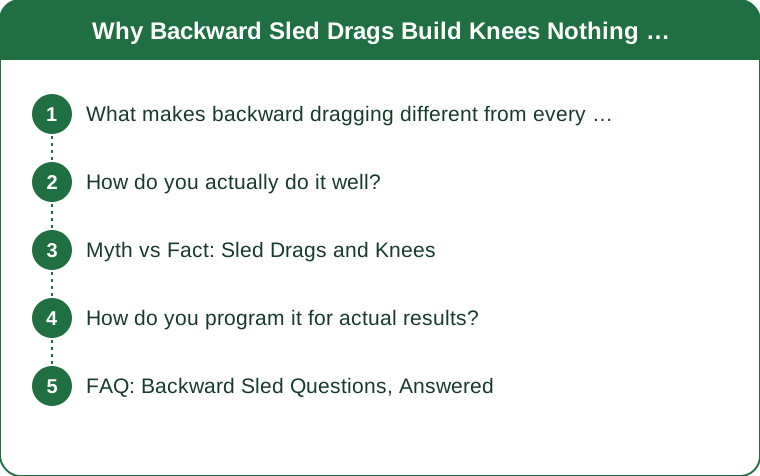
What makes backward dragging different from every squat?
The missing eccentric — and the direction your knee gets loaded from.
Almost every traditional leg exercise has two phases: lowering under load — the eccentric, where muscles lengthen while resisting — and rising under load — the concentric, where they shorten. The eccentric phase is where most muscle damage and delayed soreness comes from; it is also the phase that makes heavy leg days expensive to recover from.
A backward sled drag deletes that phase almost entirely. You push the ground away, the sled slides, and the rep ends — no lowering, no lengthening under tension, nothing to resist on the way down. Each step is a small concentric knee extension: quad shortens, force goes into the floor, done. Stack hundreds of those steps and you accumulate serious quad work with a fraction of the tissue damage an equivalent squat volume would cost. This is why a brutal sled session leaves you winded but walking normally tomorrow — and why you can drag again two days later while a squat session of equal effort would still be in your legs.
The backward direction adds the second signature: stepping backward with a lean loads the knee through ranges and angles that bias the quads — and particularly challenges the fibers stabilizing the kneecap — while keeping joint stress low, since you control depth and the motion never forces a position. Backward walking itself, even unloaded, has a rehab pedigree for exactly this reason; the sled just adds progressive resistance to a motion knees already like.
And because the load is continuous — the sled resists every single step rather than a few reps per set — the drag doubles as brutal simple conditioning. Quads, heart, and lungs split the bill on work your knees barely notice. There is no other implement in the gym offering that particular deal.
How do you actually do it well?
The technique is nearly idiot-proof — which is a feature — but four details separate productive drags from tired shuffling.
Setup: straps in hands, arms long, facing the sled. Grip the handles or straps, step back until taut, and lean away from the sled with your weight low — hips down slightly, chest up, arms straight like tow cables. The lean is the loading mechanism: more lean, more of your mass committed against the sled.
The step: push the floor away, heel-to-toe backward. Reach back with one foot, plant the ball of the foot, and drive the floor toward the sled by straightening your knee — thinking push the ground forward rather than walk backward is the cue that turns shuffling into quad work. Full extension each step: the knee finishing straight is the rep; half-extensions are half-reps.
Smooth beats lurchy. Rhythmic, continuous steps keep tension on the quads the whole trip; yank-and-pause dragging turns it into a series of jerks that load your back and grip more than your legs. If the sled moves in lurches, the load is too heavy for quality — which on a sled costs you quality only, not safety, but still costs.
Load by feel, not by plates-math. Surface friction changes everything — the same plates on rubber gym floor, turf, or concrete are three different exercises — so program by effort and speed instead: a load you can drag smoothly for 15 to 30 yards with genuinely burning quads by the end is right. Beginners: start embarrassingly light for two sessions; the burn sneaks up.
Small steps for quad bias, longer for conditioning. Short, quick steps keep the knee working through its extension range and maximize the quad emphasis; longer strides share work with hips and turn the drag more metabolic. Both are legitimate — choose per goal, per set.
Wear flat-ish shoes that grip the surface, and fitted bottoms — leggings or shorts that will not catch the strap when you turn around at the end of each length. The turnaround, not the drag, is where gym-floor dignity is traditionally lost.

Myth vs Fact: Sled Drags and Knees
Myth: sleds are for football teams and combine athletes. Fact: the backward drag’s biggest fan base is quietly the rehab world — knee-friendly quad loading is precisely what post-injury, achy-kneed, and older trainees need most and can access least through squatting. The tool scales from grandmother to linebacker by plate count alone.
Myth: if it does not make me sore, it is not building anything. Fact: soreness tracks eccentric damage, not growth stimulus. Concentric-only work builds strength and muscle with minimal soreness — the drag’s entire value proposition. Judge progress by loads, distances, and how stairs feel in a month, not by whether you waddle tomorrow.
Myth: bad knees should avoid loading until pain is gone. Fact: appropriate load is knee medicine — tendons and muscles adapt to progressive stress, and complete rest mostly builds weakness with opinions. The backward drag is often the first loaded exercise cranky knees tolerate, which is exactly why it appears early in patellar rehab progressions. The line to respect: dull working burn is fine, sharp or localized pain is a stop — and persistent knee pain deserves a professional assessment, not a heavier sled. This is general information, not medical advice.
Myth: dragging backward is dangerous because you cannot see. Fact: you steer down a straight lane you inspected ten seconds ago at walking speed with a sled anchoring you — glance over a shoulder each length and the risk rounds to zero. Choose a lane, own the lane.
Myth: the sled replaces squats. Fact: it complements them. Squats train the lowering strength and deep ranges life demands; drags add quad volume and conditioning without stacking recovery debt. The pairing — squat pattern early in the week, drags late or between — beats either alone.
Myth: no sled, no drag. Fact: the pattern survives translation — resistance-band backward walks, backward treadmill walking on incline, even pushing a plate-loaded furniture slider across carpet. The sled is the best delivery mechanism, not the only one.
How do you program it for actual results?
Three templates by goal, one progression rule, and the recovery math that makes it special.
For knee resilience — the maintenance dose: two or three sessions weekly, 4 to 6 lengths of 15 to 25 yards at a moderate load, short quad-biased steps, done after training or on off days. This is the dose that quietly changes how stairs, hikes, and lunges feel within about a month — the plan for anyone whose knees complain more than their ambition allows.
For quad growth — the volume add-on: on lower-body days after your main lifts, 6 to 10 lengths at a load that burns hard by each length’s end, short steps, minimal rest. Because the drag adds little recovery cost, it stacks quad volume onto a program that squats could not add without stealing from the next session — the classic use in knees-over-toes-style programs.
For conditioning — the engine builder: longer lengths or continuous down-and-back dragging — backward down, forward march back — for 8 to 12 minutes at a load you can sustain. It out-burns most cardio machines while training something, and the impact-free loading makes it the hard-conditioning option for people whose joints veto sprints.
The progression rule: distance, then density, then load. Add a length or two first, then shorten the rests, then add plates — the same one-variable discipline as any program, made forgiving by the sled’s low injury tax. A missed rep on a sled is just a stopped sled.
And exploit the recovery math consciously. The drag’s near-zero soreness means it can appear the day after squats, the day before them, or in a lunch-break session without wrecking anything — frequency is the sled’s superpower. The one caution is systemic: heavy drags tax breath and heart honestly, so treat big conditioning drags as the hard cardio they are when placing them in a week.
Six weeks of any template, and the test is real life: stairs descended without thought, the hike downhill that used to bill your knees arriving interest-free. The sled never posts impressive numbers — it just quietly renovates the joint everything else depends on.
FAQ: Backward Sled Questions, Answered
How heavy should I actually go?
Heavy enough that the last third of each length burns and the sled still moves smoothly — for most beginners that is startlingly light, often just the sled plus a plate on turf. Friction makes plate numbers meaningless between gyms, so anchor to the smooth-but-burning standard and let load find itself.
Forward push or backward drag — which first?
Different tools: forward pushes bias hips, calves, and full-body drive; backward drags bias quads and knees. For knee-focused goals, backward is the priority; for conditioning variety, alternate lengths — backward down, push back — which also solves the walk-of-shame back to the start.
My gym has no sled and carpeted floors. Options?
Backward treadmill walking on incline — hands lightly on rails, belt slow — is the closest substitute and a rehab staple in its own right. Band-resisted backward walks and slider drags cover home setups. The pattern is the medicine; the sled is just the nicest bottle.
Should my knees ache during drags?
A spreading muscular burn in the quads, yes — that is the exercise. Sharp, pointed, or joint-line pain, no: lighten the load, shorten the steps, and if a light smooth drag still provokes it, that knee has earned an assessment before more loading. The drag being the gentlest loaded option is precisely what makes pain during it worth taking seriously.
TL;DR:
- Backward drags are nearly pure concentric work — the sled slides instead of lowering, so quads load hard with minimal damage and almost no next-day soreness.
- The backward lean and step bias the quad fibers around the kneecap at knee-friendly angles, which is why the movement anchors knee rehab and knees-over-toes programs alike.
- Technique: lean away, arms long, push the floor away to full knee extension, smooth rhythmic steps — short steps for quads, longer for conditioning, load set by feel per surface.
- Program by goal — 4 to 6 lengths for knee health, stacked lengths after lifts for quad volume, continuous minutes for conditioning — progressing distance, then density, then load.
Next gym session, put one plate on a sled and drag it backward for four lengths of twenty yards. The burn will be immediate, tomorrow’s soreness will not exist — and in six weeks, downhill stops sending your knees the bill.
Keep Reading
This article is for general informational and styling purposes only. Fit, sizing, and product availability may vary.