The Sled Push Mistake That Wastes Half Your Workout (It's Your Arm Position)
Quick Answer: A common sled push mistake is pushing mostly with the arms and upper body at too upright an angle, which shifts work away from the legs and reduces the conditioning benefit. A lower body angle with arms mostly for steering, not pushing, fixes it.
If your arms and shoulders are more fatigued than your legs after sled pushes, that’s a sign your technique is routing effort through the wrong muscle groups — the whole point of the exercise is lower-body drive, and upright arm-pushing undermines that.

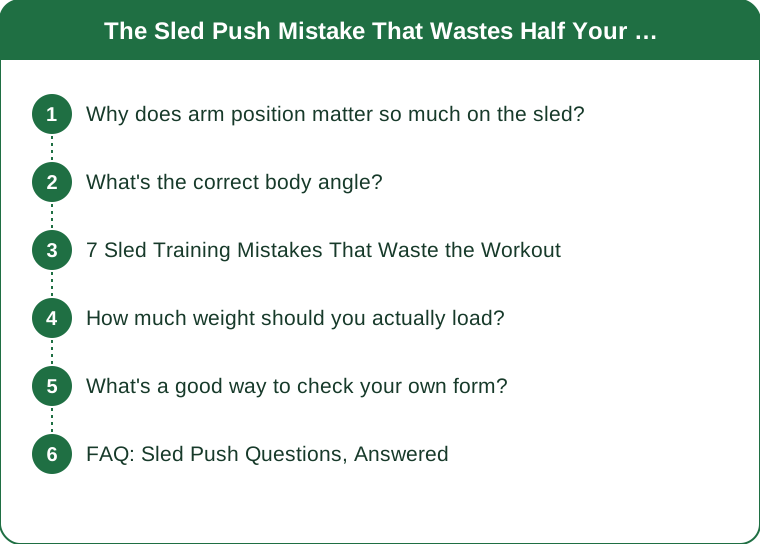
Why does arm position matter so much on the sled?
When your torso is too upright, your arms end up bearing a disproportionate share of the pushing force just to keep the sled moving, rather than the sled load traveling primarily through your hips and legs into the ground. This turns a leg-and-conditioning exercise into more of an arm-and-shoulder fatigue exercise, missing the intended training effect.
What’s the correct body angle?
A forward lean of roughly 45 degrees, driving through your hips and legs like an aggressive walking or running motion, with your arms extended mostly for balance and steering rather than generating push force. Your legs should feel like they’re doing the majority of the work, not your shoulders.
7 Sled Training Mistakes That Waste the Workout
1. Standing too upright, shifting work to arms instead of legs.
2. Short, choppy steps instead of long, powerful strides that fully use hip extension.
3. Locking the arms straight, which reduces your ability to absorb and redirect force efficiently.
4. Loading too much weight, forcing compensatory upper body strain to move the sled at all.
5. Rushing the first few steps before establishing a stable pushing rhythm.
6. Looking down at your feet instead of a fixed point ahead, which affects posture and the forward lean angle.
7. Skipping a proper warm-up, going straight into heavy loads before your hips and ankles are ready for the demand.

How much weight should you actually load?
Start lighter than you think — a load you can push with a controlled 45-degree lean and full strides, not one that forces you upright just to move it at all. Progressive overload works better here through added distance or speed first, then weight, rather than maxing out load immediately.
What’s a good way to check your own form?
Record yourself from the side for one push. You’re looking for a consistent forward lean angle throughout the push, long confident strides, and arms that stay relatively passive — not driving or pumping to move the sled.
FAQ: Sled Push Questions, Answered
Should sled pushes replace squats for leg training?
They’re complementary, not a replacement — sled pushes emphasize horizontal force production and conditioning differently than a vertical squat pattern.
Why do my calves burn more than my quads on sled pushes?
That can indicate you’re pushing off your toes too much rather than driving through a fuller foot-to-hip extension — check your stride length and forward lean.
Is sled pushing or sled pulling better for beginners?
Pushing is generally more intuitive to learn correctly first; pulling (backward sled drags) adds a different technical demand worth learning once pushing form is solid.
TL;DR:
- Standing too upright on a sled push shifts effort to your arms instead of your legs
- A roughly 45-degree forward lean with long strides puts the work where it belongs
- Start with lighter loads and progress distance or speed before adding weight
- Record your form from the side to check lean angle and stride length
If your arms are more tired than your legs after a sled push session, that’s the sign to fix your angle, not add more weight.
Keep Reading
This article is for general informational and styling purposes only. Fit, sizing, and product availability may vary.