7 Sled Push Details That Decide Whether It Builds Legs or Just Lungs
Quick Answer: Heavy sled pushes over short distances with long rest build leg strength and power. Light sleds over long distances with short rest build conditioning. Most people accidentally train the second while intending the first, because moderate load feels productive and the sled keeps moving. Load, distance, torso angle, and rest are the four dials, and they have to point the same direction.
A sled is one of the few tools that can produce two nearly opposite adaptations depending entirely on how you set it up. Get one variable wrong and you’ve spent twelve weeks conditioning while wondering why your squat didn’t move — and detail four is the one most people never adjust.

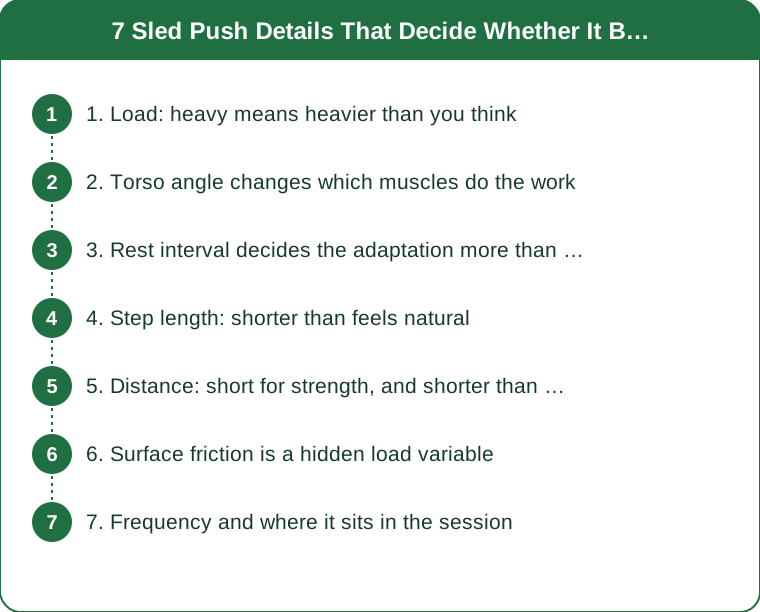
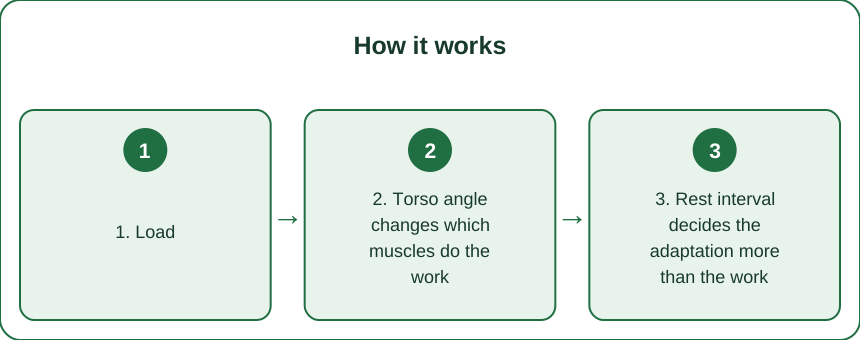
1. Load: heavy means heavier than you think
For a strength effect you want a load that reduces you to roughly 8 to 12 slow, deliberate steps over 10 to 15 yards. Not a jog. Not a fast walk. Steps you have to fight for.
As a rough anchor, that’s often bodyweight or more on turf for trained lifters, and considerably less on a rubber gym floor, which has far more friction than most people account for.
The common error is a load you can push at a brisk pace. That’s a metabolic stimulus, and a good one, but it isn’t recruiting high-threshold motor units in the quads and glutes.
Simple test: if you can talk during the push, it’s conditioning. If you can’t and the sled is genuinely slow, it’s strength work.
2. Torso angle changes which muscles do the work
This is the detail that quietly determines your entire outcome.
A low angle — torso close to 45 degrees or lower, arms extended, body in a straight line from head to heel — biases the quads and glutes, and it’s the position for heavy strength work. It requires enough load to hold you there; a light sled will pull you upright.
An upright angle — torso near vertical, arms bent, hands on the high handles — shifts emphasis toward the calves and hip flexors and turns the movement into a conditioning drill.
Neither is wrong. But an upright push with a heavy sled is where people hurt their lower backs, and a low push with a light sled just means you’re bent over jogging.
Match the angle to the load. Heavy and low, or light and upright.
3. Rest interval decides the adaptation more than the work does
For strength and power: 2 to 3 minutes between pushes. That’s long enough to restore phosphocreatine and let the nervous system reset, which is the whole point of the heavy version.
For conditioning: 30 to 60 seconds, deliberately incomplete recovery, which is what drives the metabolic and cardiovascular adaptation.
The accidental middle — 90 seconds — gives you a diluted version of both. It’s the most common rest interval in gyms and the least productive one for either goal.
This is where most training intentions die. People set up a heavy sled correctly and then rest 45 seconds because standing around feels lazy, and the fourth push is nothing like the first.

4. Step length: shorter than feels natural
The detail almost nobody adjusts, and it changes force production immediately.
Under heavy load, short, choppy, powerful steps produce more consistent force application than long reaching strides. Long steps mean a period where neither leg is driving hard, and against a heavy sled that stalls it.
Aim for steps roughly half your normal walking stride, with a deliberate full extension of the driving leg before the next step lands.
The other half of it: keep contact time short and drive through the whole foot, not the toes. Toe-only driving is what turns a leg-strength exercise into a calf-burning one and is the most common technical fault under load.
Film one set from the side. Almost everyone is surprised by how long their steps are.
5. Distance: short for strength, and shorter than the gym floor
Strength work wants 10 to 20 yards. That’s it. Long enough to accumulate meaningful work, short enough that fatigue doesn’t degrade the position.
Conditioning wants 30 to 50 yards or timed intervals.
The trap is the available space. People push whatever length their turf strip happens to be — typically 40 yards — regardless of intent, because it’s there. If your gym has a 40-yard strip and you’re doing strength work, push 15 and walk back.
What degrades past 20 yards under heavy load is the torso angle. You start upright, sag, and finish with a rounded lower back at the exact moment you’re most fatigued. That’s not a strength stimulus, that’s an injury setup.
6. Surface friction is a hidden load variable
The same plate load produces wildly different resistance across surfaces, and this is why people’s numbers make no sense between gyms.
Turf is the reference and the most forgiving. Rubber gym flooring can effectively double the resistance of the same weight. Concrete with the wrong sled runners can be either extremely slippery or brutally sticky depending on the plastic.
The practical rule: record your load along with the surface, and never compare across them. A 90 lb sled on rubber and a 90 lb sled on turf are different exercises.
Worth checking too — worn sled runners increase friction substantially. If your sled has gotten harder over a year at the same load, look underneath before you assume you got weaker.
7. Frequency and where it sits in the session
Heavy sled work is genuinely taxing on the quads and the nervous system, and it produces less soreness than the fatigue would suggest, which makes it easy to overdo.
Once or twice a week is plenty for the strength version. Conditioning pushes can run three times a week without issue because the load is low.
Placement matters: heavy pushes go early in the session, after warmup and before or alongside your main lower-body lift. Putting them at the end as a finisher guarantees you’ll do them with degraded position and moderate load — which is to say, you’ll do the conditioning version by accident.
One real advantage worth naming: sled pushing is concentric-only, with no eccentric loading, which means very little muscle damage and fast recovery. That’s what makes it useful in-season and useful for people managing joint issues who can’t handle heavy squatting.
TL;DR:
- Heavy plus low torso plus 10 to 20 yards plus 2 to 3 minutes rest equals strength.
- Light plus upright plus 30 to 50 yards plus 30 to 60 seconds rest equals conditioning.
- The 90-second rest and the moderate load are how most people end up with neither.
- Short choppy steps, full-foot drive, and surface-aware load tracking fix most technical problems.
The sled’s great virtue is that it has almost no eccentric component, so you can push hard and train again in two days. Its great trap is that it always feels like it’s working, whatever you load it with. Pick the adaptation first, set all four dials to match, and write the surface next to the weight so next month’s numbers mean something.
Keep Reading
This article is for general informational and styling purposes only. Fit, sizing, and product availability may vary.