7 Ways Cold Weather Changes Sled Training That Nobody Warns You About
Quick Answer: Cold weather changes sled training through friction, tissue temperature, and grip. Cold surfaces increase drag so the same load feels heavier, cold muscles produce less force and are more injury-prone, and reduced traction changes your body angle. Each has a specific adjustment, and the warm-up is where most of the difference is made.
You load the sled the same as always and it will not move the way it did in August. You have not gotten weaker in a week.

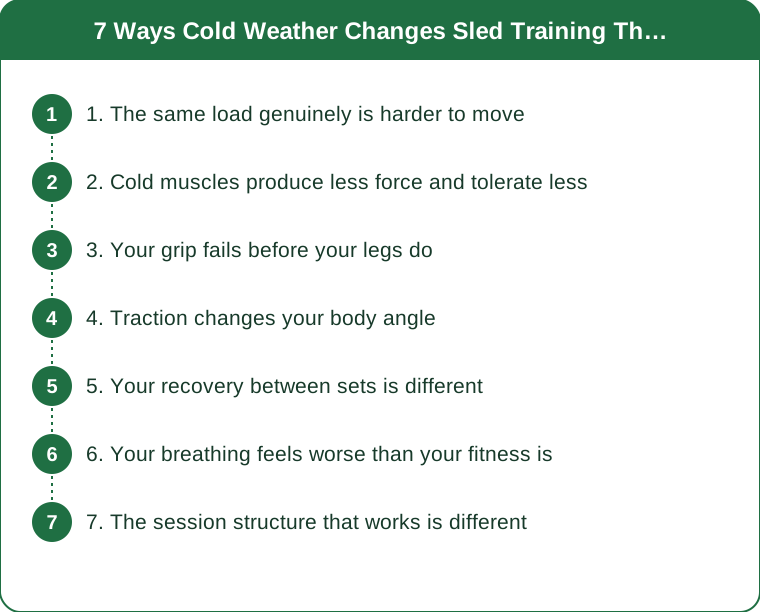
1. The same load genuinely is harder to move
Sled resistance comes from friction between the sled and the surface, and friction changes with temperature and surface condition.
On turf, cold and damp conditions make the fibers behave differently and the surface compacts. On concrete or asphalt, cold surfaces and any moisture change the coefficient of friction. The practical effect is that the same plate load requires more force to move, which is not a perception problem.
What to do: judge the load by how it moves, not by the number on it. If your working sets are noticeably slower than usual, take weight off. The training effect of a sled push depends heavily on the speed of movement, and a load that reduces you to a grind is training something different from what you programmed.
This is one of the few cases where the honest answer is to reduce the number and get the same or better session.
2. Cold muscles produce less force and tolerate less
Muscle force production drops as tissue temperature falls, and cold tissue is less compliant. That combination means less available output and a narrower margin before something strains.
Sled work is deceptive here because it feels low-risk — no eccentric loading, no barbell overhead. The risk is in the initial acceleration, which is a high-force effort from a static position, and doing that cold is exactly the profile that produces calf and hamstring strains.
The warm-up needs to be longer and more specific in cold weather. Not more stretching — more progressive work. Empty sled pushes, then light, then working weight, over five to eight minutes.
As general information rather than medical advice: a sharp pain in the calf or hamstring during a hard push is worth stopping for rather than working through.
3. Your grip fails before your legs do
Cold hands lose grip strength quickly, and sled work — particularly pulls and low pushes — depends on grip more than people account for.
This shows up as a session that ends earlier than planned for reasons that have nothing to do with conditioning. You are still capable of the work; you cannot hold on to do it.
The fix is straightforward: gloves with a grippy palm, and keeping your hands warm between sets. Pockets, or a jacket you keep on between efforts.
And on strap-based pulls, cold stiff straps behave differently from warm pliable ones, which changes the angle of pull slightly. Worth being aware of if your setup involves a harness or straps.
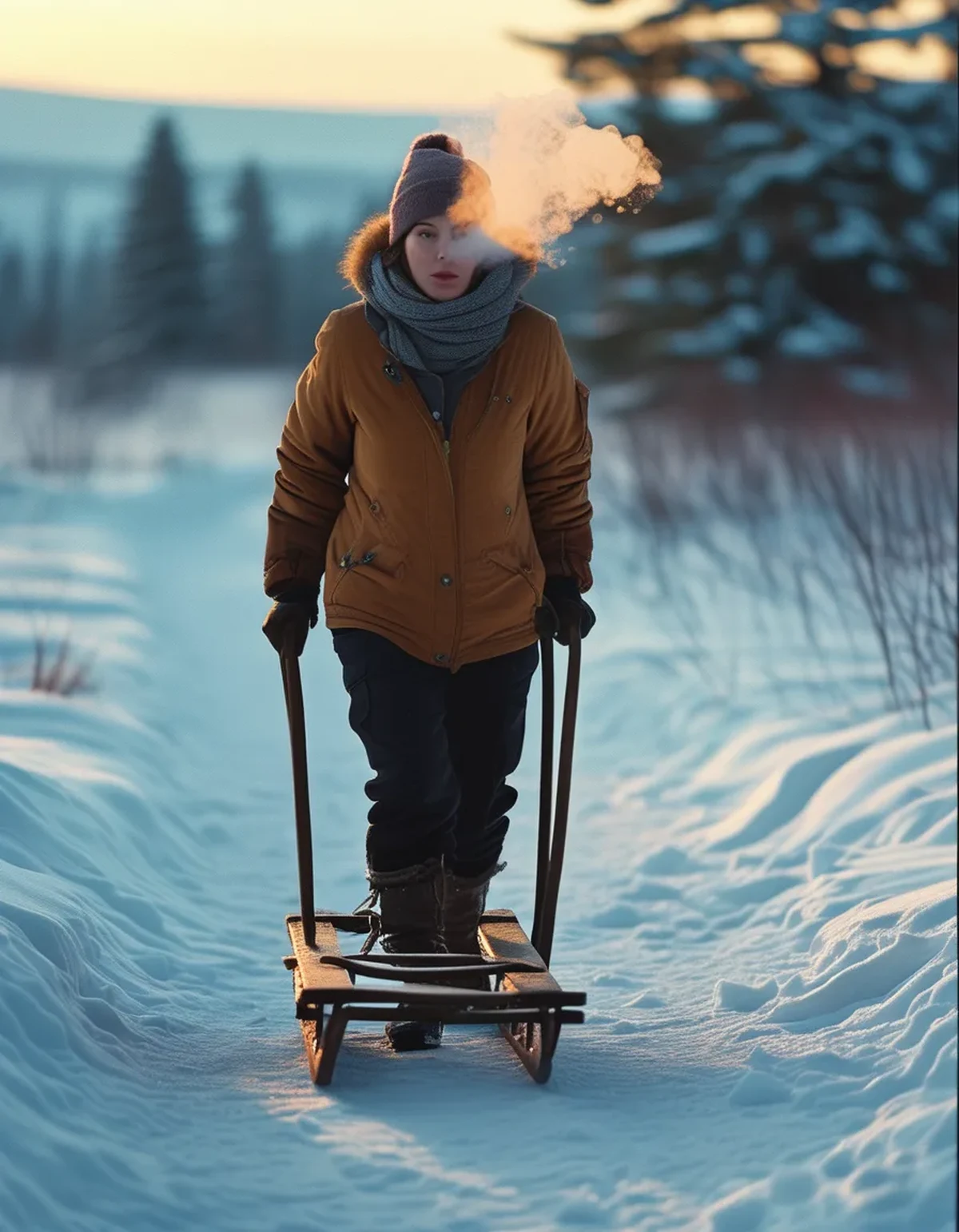
4. Traction changes your body angle
A sled push requires you to drive into the ground, and how much you can lean depends on how much grip your shoes have.
On a cold damp surface with reduced traction, you cannot lean as far forward without slipping, which forces a more upright pushing angle. A more upright push uses different muscles — more quad, less posterior chain — and produces a different training effect.
It is also less efficient, which contributes to the sled feeling heavier.
What to do: check your footwear for the surface. A shoe with genuine outsole grip matters far more in autumn than in summer. And accept that the angle may need to be more conservative, which means the load should come down to match.
5. Your recovery between sets is different
In warm weather you cool down slowly between efforts. In cold weather you cool down fast, and by the time you start the next set your tissue temperature has dropped substantially.
A three-minute rest in cold conditions leaves you starting the next effort cold, which reintroduces the force and injury issues from point two on every single set.
Two adjustments: keep a jacket on between sets and put it back on immediately after each effort, and keep rest periods shorter or stay lightly active during them — walking back to the start rather than standing still.
This is the difference between a session where set five is as good as set one and a session that degrades throughout.
6. Your breathing feels worse than your fitness is
Cold dry air is harder on the airways. Many people experience a burning sensation, more coughing, and a feeling of being more out of breath in cold conditions at the same effort.
This is a real airway response rather than a fitness change, and it is more pronounced in anyone with exercise-induced airway sensitivity or asthma.
Practical adjustments: breathe through the nose during rest periods, which warms and humidifies the air. A buff or light face covering over the mouth during high-intensity efforts genuinely helps in very cold conditions. And extend the warm-up, which lets the airways adapt gradually rather than going from rest to maximal effort in cold air.
If cold air consistently produces wheezing, chest tightness, or a cough that lasts well after the session, that is worth discussing with a doctor rather than training around. This is general information, not medical advice.
7. The session structure that works is different
Cold weather rewards a different session shape, and adjusting to it is more productive than replicating the summer plan.
What works well in cold weather:
- A longer progressive warm-up, five to eight minutes, treated as part of the session rather than a preamble
- Slightly lighter loads with faster movement, which keeps tissue temperature up and produces a better training stimulus given the friction change
- Shorter rest periods, which keeps you warm and suits the conditions
- More continuous formats — a longer pushing distance at moderate load rather than short maximal efforts with long rests
What works poorly:
- Maximal effort short pushes with long rests, which is the classic summer sled format and the one most affected by cooling between sets
- Anything requiring a long static setup in the cold
- Sessions that start with the heaviest work
The underlying principle: in cold weather, keep moving. A session built around continuous or near-continuous work maintains tissue temperature, protects against the strain risk, and delivers a strong conditioning effect. The stop-start heavy format is the one to save for warmer conditions or an indoor space.
And the practical upside worth mentioning: cold weather is genuinely excellent for conditioning work. Heat is the main limiter on sustained effort, and once it is gone you can hold a higher output for longer. Sled work in 50 degrees, with the right load and structure, is one of the better conditioning sessions available.
TL;DR:
- Cold surfaces increase friction, so judge the load by how it moves rather than by the plates on it
- Cold muscle produces less force and strains more easily — the warm-up becomes the most important part
- Grip and traction both degrade in the cold, and both end sessions before conditioning does
- Shift toward lighter loads, faster movement, shorter rests, and continuous formats, and keep a jacket on between sets
The sled did not get heavier and you did not get weaker. Friction went up, your tissue got colder between sets, and restructuring the session around staying warm turns cold weather from a limitation into the best conditioning season of the year.
Keep Reading
This article is for general informational and styling purposes only. Fit, sizing, and product availability may vary.