7 Things Sled Training Newbies Get Wrong (And How to Fix Each One)
Quick Answer: Most sled training mistakes come down to body angle, load choice, and pacing — fixing your forward lean and starting lighter solves the majority of them immediately.
Sled work looks simple: load plates, push. That simplicity is exactly why so many people get it quietly wrong for months.

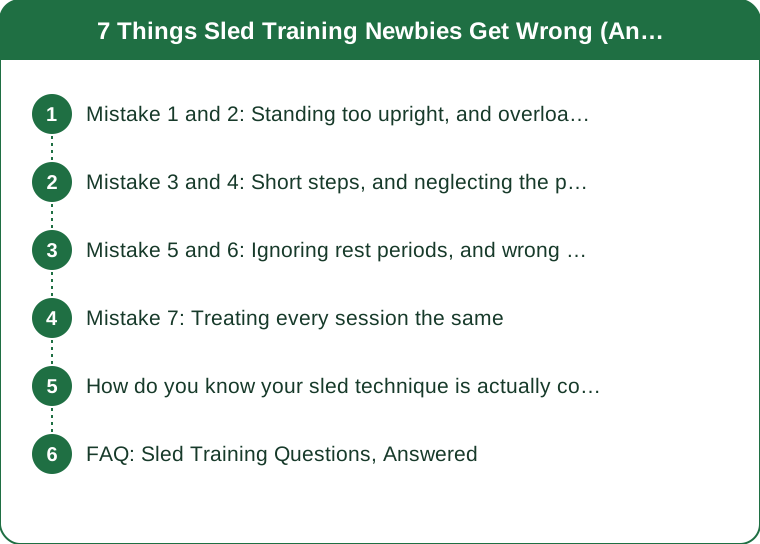
Mistake 1 and 2: Standing too upright, and overloading the sled
Mistake 1: Standing too upright during the push
An upright torso turns the sled push into a quad-dominant shuffle instead of a full-body drive, and it puts unnecessary strain on your lower back with every step. The fix is a forward lean of roughly 45 degrees, driving through your whole foot, not your toes.
Mistake 2: Loading too much weight too soon
A sled that’s too heavy forces short, choppy steps and poor posture just to move it at all, which teaches your body the wrong movement pattern before it’s learned the right one. Start light enough that you can maintain full strides for 20-30 yards, then add weight gradually.
Mistake 3 and 4: Short steps, and neglecting the pull
Mistake 3: Taking short, shuffling steps
Short steps reduce hip extension, which is where most of the power in a sled push actually comes from. Focus on full strides that let your back leg extend completely behind you before the next step.
Mistake 4: Skipping sled pulls entirely
Most people only push, but pulling (facing the sled, walking backward, or using a harness) works the posterior chain and hamstrings in a way pushing doesn’t. Programming both directions gives more balanced conditioning.
Mistake 5 and 6: Ignoring rest periods, and wrong surface expectations
Mistake 5: Not resting enough between rounds
Sled work is anaerobic-heavy, and too-short rest periods (under 60-90 seconds for heavier loads) just turn a strength tool into a fatigue exercise with sloppier and sloppier form each round.
Mistake 6: Expecting the same feel on every surface
Turf, rubber, and concrete all create different friction, so the same weight load feels completely different across gyms — don’t judge your progress by absolute plate count alone, judge it by how controlled your form stays.

Mistake 7: Treating every session the same
Mistake 7: Never varying load or distance
Heavy-short sled pushes (10-15 yards, near-max load) build power, while light-long pushes (40+ yards) build conditioning — using only one style limits what you actually get out of sled training. Rotating between the two across the week trains both qualities instead of just one.
How do you know your sled technique is actually correct?
A reliable check: film yourself from the side for 10 yards. Your torso should form a consistent lean angle throughout the push (not straightening up halfway), and your steps should look even in length rather than getting shorter as you fatigue. If either breaks down, that’s your load-too-heavy signal, not a sign to push harder.
FAQ: Sled Training Questions, Answered
How often should beginners do sled training?
Once or twice a week is enough to build the skill and see conditioning benefits without excessive soreness derailing other training days.
Is sled training better than running for conditioning?
They train different things — sled work is lower-impact on joints and builds strength-endurance, while running builds different cardiovascular adaptations, so they complement rather than replace each other.
Can sled pushes replace squats for leg strength?
No — sled work is a great conditioning and power tool, but it doesn’t provide the same range-of-motion loading as a proper squat, so it should supplement, not replace, traditional strength training.
TL;DR:
- Lean forward about 45 degrees instead of standing upright
- Start lighter than you think and prioritize full strides
- Don’t skip pulls — they balance out what pushing misses
- Rest enough between rounds to keep form clean
- Vary between heavy-short and light-long sessions across the week
Sled training rewards patience with technique far more than it rewards raw plate count — fix the form first and the results follow.
Keep Reading
This article is for general informational and styling purposes only. Fit, sizing, and product availability may vary.