7 Sled Variations That Train Completely Different Things
Quick Answer: Sled work varies enormously by direction, load, handle height, and speed. Heavy low pushes train horizontal force production and hip extension. Light fast pushes train acceleration mechanics. Backward drags load the quads heavily with no eccentric component, making them the standard choice for knee rehabilitation. Lateral drags target the hips in the frontal plane, and rope pulls train the upper body. Doing one variation forever means training one quality forever.
The sled’s real advantage is that it has almost no eccentric loading, which means high training volume with very little soreness.
This blog has covered sled training muscle groups, sled training for runners’ conditioning, and the sled push mistake that wastes most of the workout. This is the variation guide.
1. The heavy low push
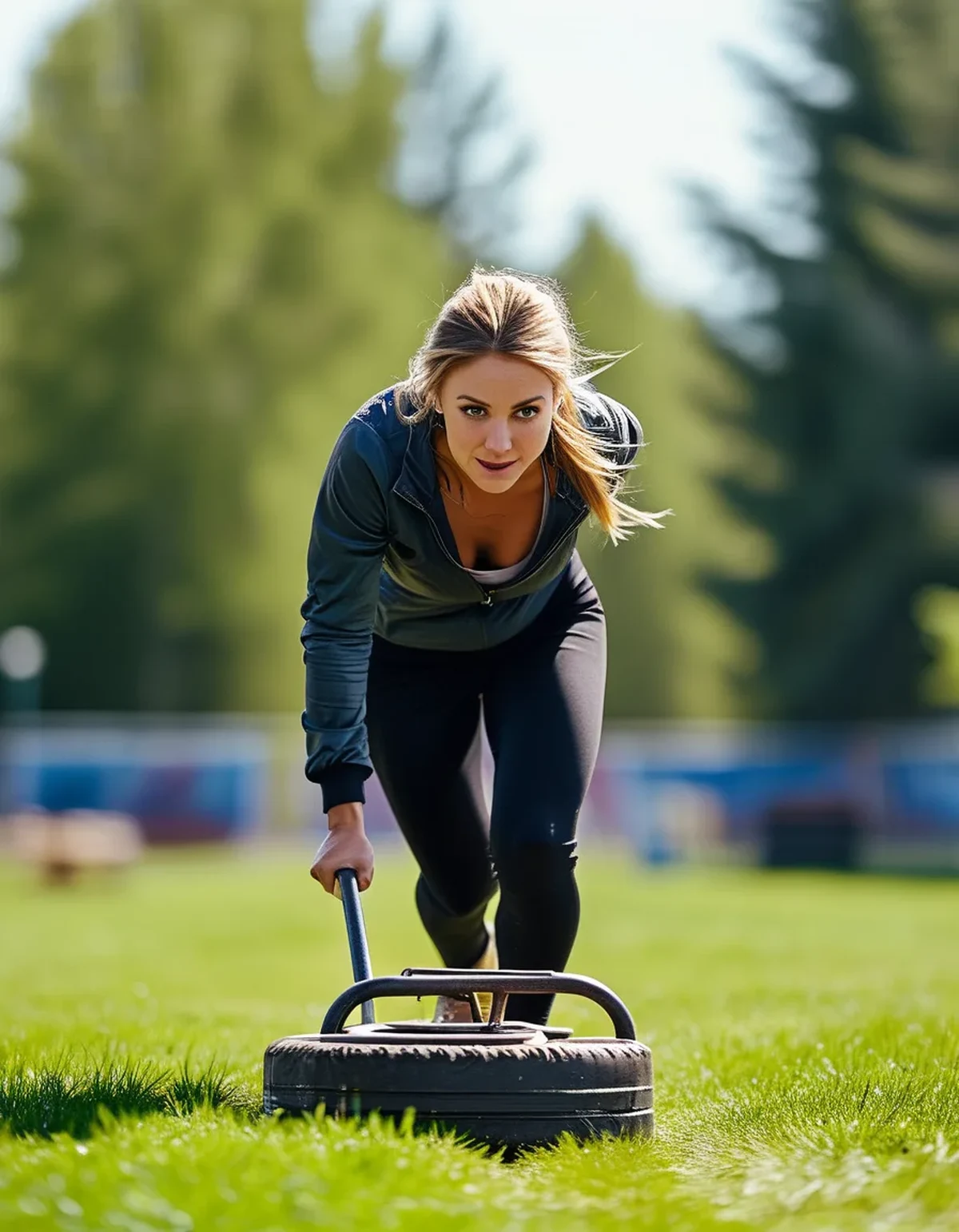
Load heavy enough that you move at a walking pace or slower, with low handles and a forward torso lean of roughly 45 degrees. This is the strength end of the sled spectrum.
The low handle position and forward lean put you in a position of maximum horizontal force production, which is where the glutes and hamstrings do the most work.
Sets of 15 to 25 metres with full recovery. This is a strength exercise, so treat rest like a strength exercise: two to three minutes between efforts.
Watch for the torso collapsing. As you fatigue, the lower back rounds and the hips rise. That is the end of the useful set regardless of how much distance is left.
Best used as a lower-body strength accessory after your main lifts, or as a standalone session when you want hip and leg loading with no spinal compression.
Excellent for anyone who cannot load their spine. The sled produces high leg force with essentially no axial load, which makes it uniquely useful for people managing back issues.
2. The light fast push
Load light enough that you can genuinely accelerate and run, with high handles and a more upright torso. Completely different exercise, same equipment.
This trains acceleration mechanics and rate of force development rather than maximum force. It is a power and speed tool.
Sets of 10 to 20 metres at maximum intent, with generous rest. Three minutes between efforts is not excessive. Quality collapses fast and a slow rep trains the wrong thing.
The load matters more than people think. Research on sled sprinting suggests loads that slow you by roughly 10 to 30 percent of your unloaded sprint speed for acceleration work. Heavier than that becomes a different exercise.
Stop the set when speed drops. This is not a conditioning exercise, and turning it into one by pushing through fatigue defeats the purpose entirely.
Particularly valuable for runners and field sport athletes, where horizontal force production in the acceleration phase transfers directly.
3. The backward drag
Face the sled, hold the straps or handles, and walk backwards pulling it toward you. This is the quad-dominant variation and it is the one with the most specific application.
The knee extension against resistance loads the quadriceps heavily, and because the sled provides no eccentric loading, it produces almost no muscle damage or soreness.
This combination is why backward sled drags are a staple in knee rehabilitation. High quad loading, no eccentric stress, no impact, and easily scalable load. Many physiotherapists use them extensively for exactly this reason.
Sets of 20 to 40 metres, moderate load, minimal rest. These can be done at high volume because the recovery cost is so low.
Stay low with a soft knee bend throughout. Standing tall turns it into a walk with a rope. The knee bend is where the quad work happens.
Add them as a finisher two to three times a week if knees are your limiter. Volume here is far better tolerated than volume in almost any other quad exercise.
If you are working around a knee injury, do this under proper guidance. This is general information, not medical advice, and rehabilitation loading should be set by a physiotherapist who has assessed you.

4. The lateral drag
Stand side-on to the sled and shuffle sideways, pulling it with both hands or a belt. This loads the frontal plane, which almost nothing else in a normal program does.
The hip abductors and adductors work hard, and the demand on the trailing leg’s hip is substantial.
Sets of 15 to 20 metres each direction. Doing both directions is not optional, and most people find one side noticeably harder, which is useful information.
Keep the hips level and facing forward. Rotating to face the direction of travel turns it back into a forward drag and removes the entire point.
Valuable for anyone in a sport with lateral movement, and for anyone whose training is exclusively sagittal plane, which describes most gym programs.
Start lighter than you expect. The frontal plane is generally undertrained and the muscles involved fatigue quickly at loads that feel trivial in a forward push.
5. The rope pull
Sit or stand and pull the sled toward you hand over hand with a rope. This turns the sled into an upper body pulling exercise.
The back, biceps, and grip take the load, and the continuous nature makes it a strong conditioning stimulus alongside the strength component.
Standing pulls involve more of the body, with the legs and trunk bracing against the pull. Seated pulls isolate the upper body more.
Sets of 20 to 30 metres of rope. Grip is usually the limiting factor, which is itself a useful training effect.
Alternate hand-over-hand with both-hands-together pulls. They load slightly differently and both are useful.
A genuinely good option on days when your lower body is fatigued, since it delivers a substantial conditioning effect without loading the legs at all.
6. The single-arm push or drag
Push or drag with one arm, which forces your trunk to resist rotation for the whole set. This is an anti-rotation exercise disguised as a sled exercise.
The obliques and the whole lateral chain work continuously to stop your torso twisting toward the loaded side.
Sets of 15 to 20 metres per side, moderate load. Heavier loads make it impossible to maintain position, which defeats the purpose.
Keep the hips square. The moment they rotate, the anti-rotation demand disappears and you are just doing an awkward push.
Excellent for identifying asymmetry. Most people are noticeably worse on one side, and the sled makes that impossible to hide in a way that bilateral work does not.
Combines well with the lateral drag as a frontal and transverse plane pairing that covers what conventional training misses.
7. The march
Heavy load, deliberately slow, with an exaggerated high knee drive and a pause at the top of each step. This is the most technical variation and the most specific.
It trains single-leg hip extension and hip flexion under load, with a substantial balance and control component from the pause.
Sets of 10 to 15 metres, heavy, slow. Distance is short because the time under tension per metre is very high.
The pause is the exercise. Without it, this is just a slow push. Holding the knee up for a count at the top of each step is what creates the single-leg stability demand.
Particularly useful for runners because the position closely mirrors the drive phase of a stride under considerably more load than running provides.
Expect it to expose hip flexor endurance limitations that nothing else in a normal program reveals.
A general note on sled programming: because there is almost no eccentric loading, sled work produces very little soreness and can be repeated more frequently than most training. Three to four sessions a week is realistic where the same volume of squatting would not be, and that repeatability is the sled’s main strategic advantage.
TL;DR:
- Heavy low pushes train horizontal force and hip extension; light fast pushes train acceleration. Different loads, different exercises.
- Backward drags load quads heavily with no eccentric stress, which makes them the standard knee rehabilitation choice.
- Lateral drags and single-arm work cover the frontal and transverse planes that most gym programs skip entirely.
- Rope pulls give a full conditioning effect with no leg loading, which is useful on fatigued lower-body days.
The sled’s real advantage is minimal eccentric loading, so you can train it three to four times a week without the soreness cost.
Keep Reading
This article is for general informational and styling purposes only. Fit, sizing, and product availability may vary.