7 Sled Training Mistakes That Are Wasting Half Your Workout
Quick Answer: Sled training’s effectiveness comes almost entirely from consistent body angle and drive mechanics, and a handful of common setup mistakes quietly cut the actual training stimulus well below what the effort level suggests.
Sled work looks simple — load it, push it — which is exactly why small mistakes go unnoticed for months.

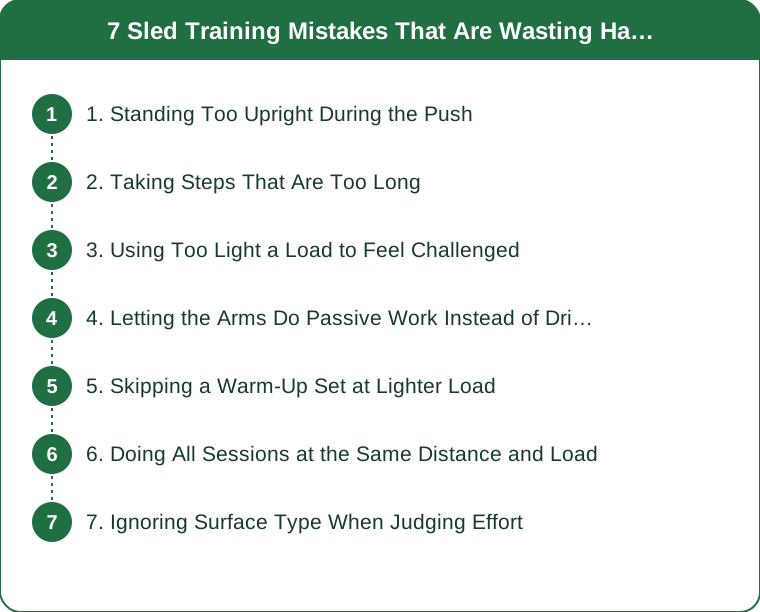
1. Standing Too Upright During the Push
An upright torso shifts effort away from the legs and glutes, which are the primary target muscles in most sled protocols, and shifts more load onto the lower back instead. A forward lean of roughly 45 degrees keeps the drive coming from the legs where it’s supposed to.
2. Taking Steps That Are Too Long
Overly long strides during a sled push reduce the frequency of ground contact and drive, cutting the total force output over a given distance. Shorter, more frequent, powerful steps generate more consistent forward drive than long, loping strides.
3. Using Too Light a Load to Feel Challenged
A sled loaded too light lets momentum carry the movement instead of requiring continuous force production, which reduces the strength-and-power stimulus the exercise is meant to provide. The load should feel genuinely effortful from the very first step, not just by the end of a set.

4. Letting the Arms Do Passive Work Instead of Driving
On sled pushes with handles, arms that just hang on for the ride rather than actively driving forward waste available force output — actively pushing through the arms in coordination with the legs adds meaningfully to total drive rather than the legs doing all the work alone.
5. Skipping a Warm-Up Set at Lighter Load
Going straight into a heavy working set without a lighter warm-up push increases injury risk and often results in worse form on the first working set, since the body hasn’t rehearsed the movement pattern yet at that session.
6. Doing All Sessions at the Same Distance and Load
Sled training adapts quickly, and sticking to the exact same distance and load session after session plateaus results faster than varying between heavier-short-distance and lighter-longer-distance sessions across a week.
7. Ignoring Surface Type When Judging Effort
The same load feels dramatically different on turf versus asphalt versus a rubber track due to friction differences, so judging progress purely by weight loaded without accounting for surface change leads to inconsistent, hard-to-interpret training data over time.
TL;DR:
- Sled training’s benefit comes from consistent angle, step frequency, and drive, not just load
- Standing too upright shifts effort away from the legs and glutes
- Load should feel challenging from the first step, not just toward the end
- Actively driving through the arms adds real force output on push variations
- Surface type changes effective resistance even at the same loaded weight
Small form fixes here add up to a meaningfully more effective session at the same effort level.
Keep Reading
This article is for general informational and styling purposes only. Fit, sizing, and product availability may vary.