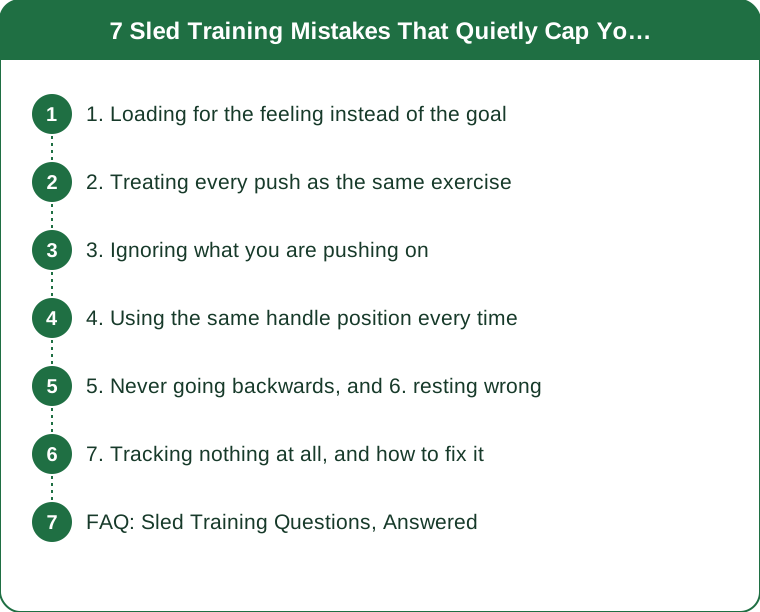
7 Sled Training Mistakes That Quietly Cap Your Progress
Quick Answer: The seven are: loading for the feeling rather than the goal, no distinction between heavy pushes and conditioning pushes, ignoring the surface, using the same handle height every session, no backward work, rest periods that turn strength work into cardio, and never tracking anything. The sled is forgiving of technique and unforgiving of programming, so the errors are almost all decisions rather than form.
Nobody gets hurt on the sled and nobody gets injured from bad sled form.
Which is why nobody ever examines their sled training, and why most of it stays at the same level for years.

1. Loading for the feeling instead of the goal
The sled always feels hard, so people load until it feels hard and stop thinking. That is a satisfying session and a directionless one.
Heavy sled work - slow, grinding, near-maximal pushes - trains force production and looks like a very slow walk. It should feel like a leg press, not like cardio.
Light sled work trains speed and conditioning and should move quickly, with your stride recognisable as running.
Loading in the middle produces the worst of both: too heavy to move fast, too light to be a strength stimulus.
Pick the intent before you load the sled, then load to match. This one change accounts for most of the improvement available.
A rough guide: if you are aiming for speed and your stride has collapsed into a shuffle, take weight off.
2. Treating every push as the same exercise
A 20 metre heavy push and a 60 metre light push are different exercises with different adaptations, and running them in the same session without distinction blurs both.
Short and heavy: 10 to 20 metres, long rest, full effort. This is strength work.
Medium and moderate: 20 to 40 metres, moderate rest. This is the general fitness zone and the most common.
Long and light: 40 to 100 metres, short rest. This is conditioning.
Choose one per session, or sequence them deliberately with heavy first while you are fresh.
Mixing them randomly within a session is the default, and it is why sled progress plateaus so predictably.
3. Ignoring what you are pushing on
Surface changes effective load enormously. The same weight on turf, rubber, concrete and outdoor tarmac produces dramatically different resistance.
Which means your training log is meaningless if the surface changed, and people frequently conclude they got weaker after a gym moved its sled lane.
Turf is typically the highest friction, rubber mats sit in the middle, and smooth concrete is the fastest.
Temperature and moisture change it too - a damp outdoor surface in October is a different exercise from the same lane in August.
Note the surface with the weight in whatever you track, which takes two words and preserves the value of the whole log.
And if you only have one surface, this simply becomes a constant - which is fine, as long as you know that is what it is.

4. Using the same handle position every time
High handles keep you more upright, loading the quads more and allowing a more running-like stride.
Low handles put you in a forward lean with a longer lever, which shifts more work to the posterior chain and makes the push considerably harder at the same weight.
Most people use whichever is on the sled and never switch, which means half the available stimulus goes untouched.
Alternate by block rather than by set, so you can actually compare progress within a handle position.
Rope and strap work is a third category and produces a different body position again, particularly useful for drags.
And note the handle position in your log, because comparing a high-handle push to a low-handle one is comparing two different exercises.
5. Never going backwards, and 6. resting wrong
5. Backward drags are the most skipped useful thing
Backward sled dragging loads the quads through a range and in a manner that few other exercises replicate, which is why it appears so consistently in knee rehabilitation and general knee-health programming.
It is low impact and produces very little soreness, which makes it usable frequently.
Two to three sets of 20 to 30 metres is a reasonable addition to almost any lower body day.
Most people skip it because it looks slow and unimpressive, which is a poor reason. This is general information, not medical advice.
6. Rest periods that convert strength work into conditioning
Heavy pushes need long rest - 2 to 3 minutes, because the point is force output and force output falls quickly.
Resting 45 seconds between heavy pushes turns the session into conditioning at a weight too heavy to condition well.
Conditioning work has short rest by design, which is fine when that is what you chose.
The error is using conditioning rest with strength loading, which produces a very difficult session that develops neither well.
7. Tracking nothing at all, and how to fix it
The sled is the least-tracked piece of equipment in most gyms, because it does not have obvious numbers on it.
But it has four: weight, distance, rest, and surface. Recording those four takes ten seconds and turns the sled into a progressible exercise.
Add handle position and it becomes fully comparable session to session.
Without tracking, sled work drifts toward whatever felt right that day, which is almost always the same moderate zone.
With tracking, you can actually progress - add 5 to 10 kg per block on heavy work, or hold weight and reduce rest on conditioning work.
Time the pushes too if you can. A 20 metre heavy push timed is one of the cleanest progress markers available, and it takes a phone stopwatch.
And review monthly rather than weekly, since sled numbers move less smoothly than barbell numbers.
FAQ: Sled Training Questions, Answered
How heavy should a sled push be?
It depends entirely on intent. Heavy strength work should slow you to a grinding walk over 10 to 20 metres; speed work should let you keep a recognisable running stride. Load to the intent, not to the feeling.
How often can I do sled work?
Because concentric-only work produces relatively little muscle soreness, sleds are generally tolerated more frequently than heavy lifting - two to four times a week is common. Adjust to your total training load.
Are backward drags really that good for knees?
They are widely used in rehabilitation settings and are a low-impact way to load the quads, which is why they appear so often. Whether they suit your specific situation is a question for a healthcare professional. This is general information, not medical advice.
Can sled training replace squats?
Not fully - the sled lacks the eccentric loading that drives much of the adaptation from squatting. It complements barbell work rather than substituting for it.
Why does the sled feel harder some days at the same weight?
Surface condition, temperature, moisture, footwear and accumulated fatigue all change it. This is exactly why recording the surface is worth doing.
Does footwear matter?
A lot. Flat shoes with good grip transform a heavy push; cushioned running shoes lose force into the midsole and slip more on turf.
Should I push or drag?
Both. Pushing emphasises a forward-lean drive; forward dragging with straps changes the body angle; backward dragging targets the quads differently again. Rotating between them is more useful than picking one.
TL;DR:
- Decide the intent before you load - heavy strength, moderate general, or light conditioning.
- Do not mix push types randomly within a session; sequence heavy first.
- Surface changes effective load enormously, so record it alongside the weight.
- Alternate handle heights by training block, not by set.
- Backward drags are the most skipped useful thing on the sled.
- Heavy work needs 2 to 3 minutes rest; short rest turns it into poor conditioning.
- Track weight, distance, rest, surface and handle position - ten seconds a set.
The sled is forgiving of form and unforgiving of programming. This is general information, not medical advice.
Keep Reading
This article is for general informational and styling purposes only. Fit, sizing, and product availability may vary.