7 Sled Push Mistakes That Waste Half Your Workout (In Order of How Common They Are)
Quick Answer: Most wasted sled-push effort comes from body position, not weight or speed — leaning too upright and short, choppy steps account for most of the lost training effect. Fix your body angle and stride length first before adding more weight.
Sled pushes look almost too simple to mess up — put your hands on it, push, walk. That simplicity is exactly why these 7 mistakes fly under the radar for months, quietly cutting the actual training effect of every single push.

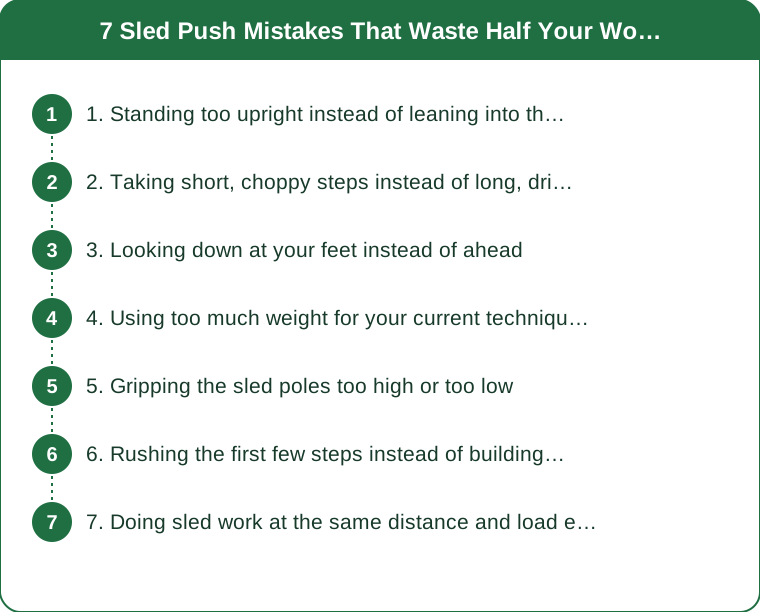
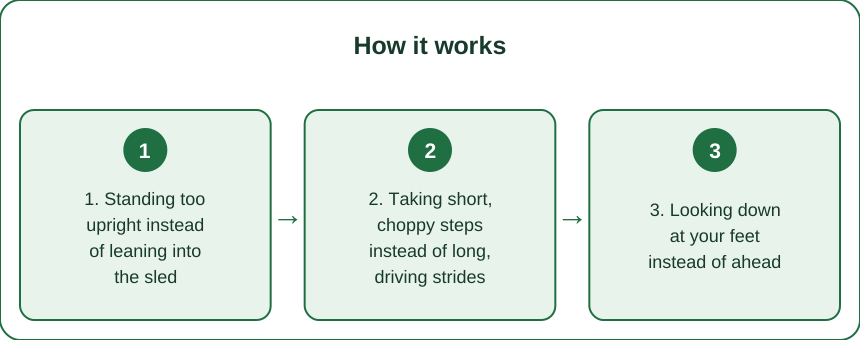
1. Standing too upright instead of leaning into the sled
This is the most common mistake by a wide margin. An upright torso relies mostly on your calves and short, quick steps to move the sled, sharply limiting how much force your hips and glutes — the muscles sled training is meant to target — actually contribute. Lean your torso forward until your shoulders are roughly over or slightly ahead of your hands on the sled poles, driving from your hips.
2. Taking short, choppy steps instead of long, driving strides
Short steps keep you in a constant low-power, high-frequency pattern that taxes your calves and cardio system heavily but under-uses the powerful hip extension the sled is best suited to train. Longer, more deliberate driving strides — almost like an exaggerated running stride — recruit far more glute and hamstring power per step.
3. Looking down at your feet instead of ahead
Looking down rounds your upper back and neck forward, which pulls your whole torso posture out of the ideal forward-lean drive position described above. Keeping your gaze forward, roughly where you’re walking rather than at your feet, helps maintain the correct full-body lean angle.

4. Using too much weight for your current technique level
Loading heavy weight before your lean angle and stride length are solid just reinforces poor mechanics under load, since you’ll unconsciously default to whatever position lets you move the weight at all — usually upright and choppy. Master technique at a lighter weight first, then add load progressively.
5. Gripping the sled poles too high or too low
Hand position that’s too high forces a more upright torso; too low can round the back excessively forward. A grip roughly at hip-to-lower-chest height, adjustable on most sled designs, supports the ideal forward-lean angle better than either extreme.
6. Rushing the first few steps instead of building into the push
Sleds have real inertia to overcome from a dead stop — trying to explode into full speed immediately from standstill often causes exactly the upright, short-step compensation pattern the first few mistakes describe. A slightly more gradual build over the first 2-3 steps, then driving into full stride, uses better mechanics throughout.
7. Doing sled work at the same distance and load every single session — Plus Your Sled Push FAQ
This isn’t a form mistake, but it wastes training potential — sled work responds well to varied protocols (heavy-short-distance for power, lighter-longer-distance for conditioning), and using the identical setup every session limits which adaptations you’re actually training toward.
How do I know if my forward lean angle is correct?
A training partner or a mirror check from the side — shoulders should be roughly stacked over or slightly ahead of your hands on the poles, not upright with hands extended far in front.
Should sled pushes replace squats or deadlifts?
They complement rather than replace — sled work trains horizontal force production differently than vertical lifts, and both have a place in a well-rounded program.
How much weight should a beginner start with?
Light enough that correct lean angle and full stride length are easy to maintain for the full distance — add weight only once that technique feels automatic, not effortful to maintain.
TL;DR:
- Standing too upright and taking short choppy steps waste most of a sled push’s training value
- Lean your torso forward, drive with long strides, and keep your gaze ahead, not down
- Master technique at lighter weight before loading up heavier
- Vary distance and load across sessions rather than using the same setup every time
Next sled session, film yourself from the side for one pass — checking your lean angle on video usually reveals more than it feels like in the moment.
Keep Reading
This article is for general informational and styling purposes only. Fit, sizing, and product availability may vary.