7 Signs You're Using Way Too Much Weight on the Sled
Quick Answer: The clearest sign the sled is loaded too heavy is that your torso angle collapses forward past roughly 45 degrees and your steps shorten into a shuffle rather than a stride — at that point you’re no longer training the intended movement pattern, you’re just grinding against too much resistance with worse mechanics.

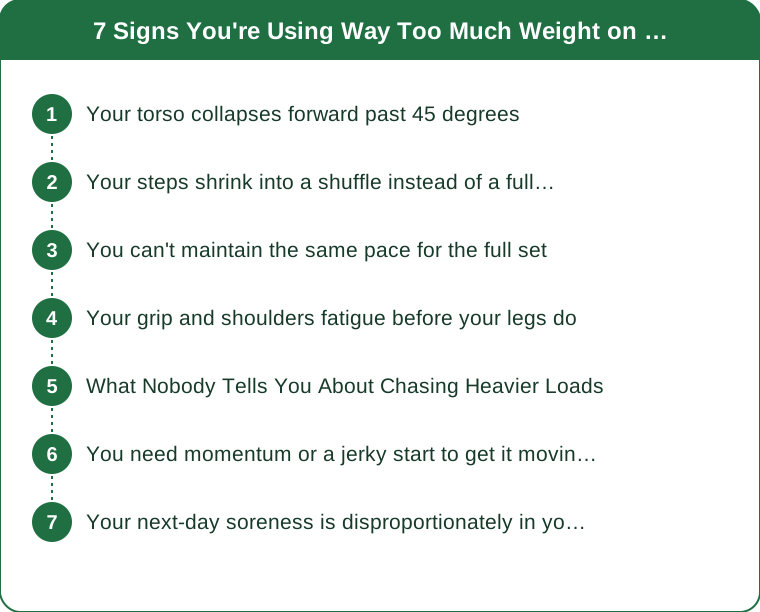
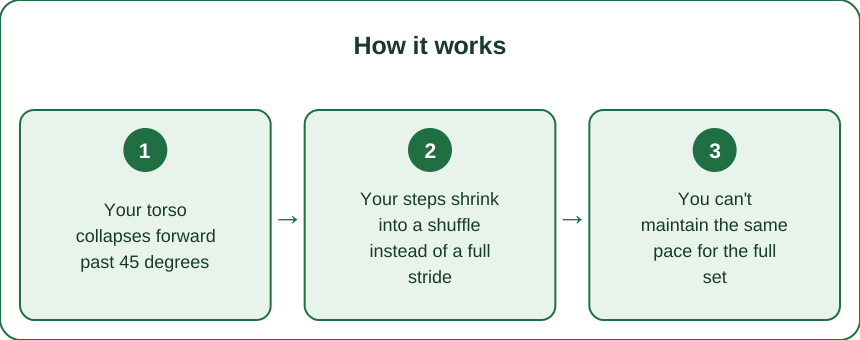
Your torso collapses forward past 45 degrees
A properly loaded sled push lets you maintain roughly a 45-degree forward lean with a straight line from ankle to shoulder — once the weight forces your chest much closer to horizontal, you’ve shifted from a controlled push into essentially dragging yourself forward, which changes which muscles are actually doing the work.
Your steps shrink into a shuffle instead of a full stride
Excess weight often shows up first in stride length before anything else — a sled push should involve real, extended steps driving through the ground, and when the weight is too heavy, steps compress into small, shuffling movements that barely qualify as a stride at all.
You can’t maintain the same pace for the full set
A sled loaded appropriately for your training goal should let you maintain a consistent pace across the prescribed distance or time — if you’re fast for the first five yards and crawling by the end of a 20-yard push, the weight is likely calibrated for a much shorter effort than you’re programming.

Your grip and shoulders fatigue before your legs do
When the sled is properly weighted for a leg-driven push, your legs should fatigue before your grip does — if your forearms and shoulders are burning out first while your legs still have gas left, the excess resistance is forcing you to compensate with your upper body to keep the sled moving at all.
What Nobody Tells You About Chasing Heavier Loads
Sled training has less of a direct ‘heavier is always better’ relationship than barbell lifts do, because the goal is usually power output and movement quality over a distance, not a one-rep max — chasing the heaviest possible load often works against the actual training purpose rather than toward it.
You need momentum or a jerky start to get it moving at all
A sled that requires a violent, jerking initial pull just to overcome static friction is loaded beyond a productive training range for most goals — the push should be demanding but smoothly initiated, not reliant on a herky-jerky start that stresses joints more than muscles.
Your next-day soreness is disproportionately in your lower back, plus FAQ: Sled Training Weight
Appropriately loaded sled work should primarily fatigue the glutes, quads, and calves, not the lower back — if lower back soreness dominates the day after, it’s a strong signal that forward lean has become compensation for weight rather than intentional technique, which is a load problem more often than a technique-only problem.
Is there a standard weight-to-bodyweight ratio to start with?
Many coaches suggest starting around 50-75% of bodyweight for general conditioning pushes and adjusting based on how well form holds up, rather than following a fixed universal number.
Should sprint-style sled work use lighter loads than strength-style sled work?
Yes — sprint-focused sled pushes generally use lighter loads to preserve running mechanics and speed, while strength-focused pushes intentionally use heavier loads at a slower pace.
How quickly should someone reduce weight after noticing these signs?
Immediately for that session — dropping weight right away to restore proper form and stride length is more productive than finishing a set with breakdown mechanics already underway.
TL;DR:
- Torso collapse past 45 degrees and shuffled steps are the earliest signs of overload
- Pace should stay consistent across the set — fading hard by the end signals excess weight
- Legs should fatigue before grip and shoulders do
- Lower back soreness the next day often points to compensation, not just intensity
Heavier isn’t automatically better on the sled — the weight that lets you keep good mechanics for the whole set is doing more for you than one that breaks you down halfway through.
Keep Reading
This article is for general informational and styling purposes only. Fit, sizing, and product availability may vary.