7 Reasons the Same Sled Weight Feels Completely Different Day to Day
Quick Answer: Sled resistance is dominated by friction, and friction depends on the surface, the sled’s contact skis, humidity, temperature, and how recently the turf was cleaned - none of which is your strength. Add body angle, fatigue, and where on the lane you start, and the same plate load can vary enormously in how it feels. Track distance and time, not plate weight, if you want a comparable number. The plates are the least informative variable on the sled.
Seven reasons, in the order they usually apply.

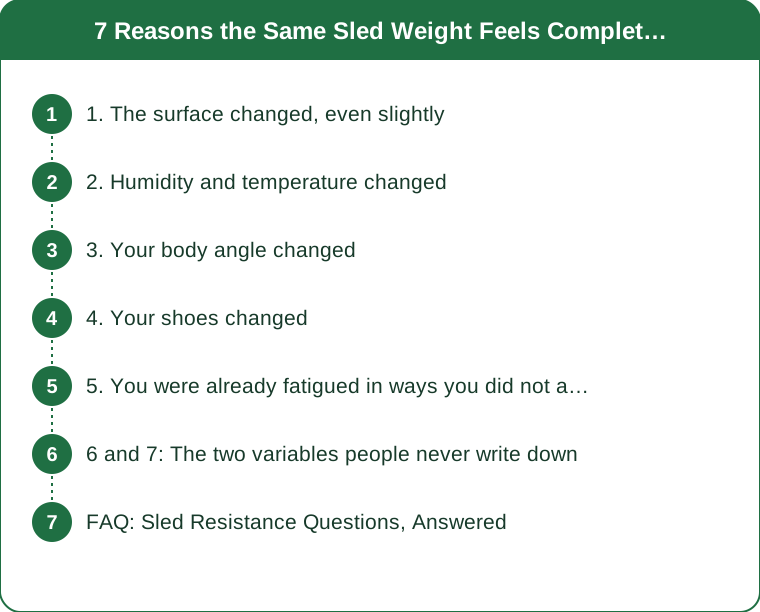
1. The surface changed, even slightly
Friction is the dominant force in sled work, not gravity - unlike a barbell, where the load is the load.
Turf condition varies enormously. Freshly brushed turf with the fibres standing up produces far more resistance than flattened, worn turf, and a lane that has been used all day is measurably faster than a freshly groomed one.
Different lanes in the same gym differ. The lane by the door gets more traffic and is more compressed than the one at the back. Using a different lane is a different workout at the same weight.
Rubber flooring, concrete, and turf are three completely different resistances. A sled that moves easily on rubber can be nearly immovable on high-pile turf at the same load.
And debris matters. Chalk, dust, and grit under the skis increase resistance noticeably.
Fix: use the same lane, in the same direction, and note it. If you want comparable sessions, the surface has to be the constant.
2. Humidity and temperature changed
Both affect the friction coefficient between the sled skis and the surface, and gyms vary a great deal across a year.
Humid air increases friction on most surfaces. A humid August session and a dry October session on the same turf are genuinely different resistances, and this is a common autumn observation.
Cold plastic skis behave differently from warm ones. Polyethylene skis harden slightly in the cold, which changes how they glide.
A cold garage or warehouse gym compounds it. Cold turf fibres are stiffer and stand up more, producing more resistance than the same turf in a warm room.
Your own warm-up state matters here too. The first push of a cold session in a cold room is the hardest push of the week, and it is not the sled.
Fix: warm up properly and expect seasonal drift. A load that was your working weight in summer may be a genuine step up in an unheated gym in autumn.
3. Your body angle changed
The angle of your torso determines how much of your force goes into moving the sled forward versus pressing it into the floor.
Too upright and you push down rather than forward. A vertical torso directs force into the ground, increasing the normal force and therefore the friction - you are literally making the sled heavier.
Too low and you lose leg drive. An extremely flat body angle limits how much force your legs can produce through the available range.
The useful range is roughly a 45 degree line from hands to heels, with the body straight and braced. Small changes in this angle produce large changes in how the sled feels.
Arm position sets the angle. High handles force you upright; low handles let you get behind it. Using a different sled with different upright heights changes everything, at the same weight.
And fatigue raises your angle. As you tire you drift upright, which is why the second half of a push always feels disproportionately harder.
Fix: film one push from the side. Body angle is nearly impossible to feel and immediately obvious on video.

4. Your shoes changed
Traction is what transmits your force to the floor, and a shoe that slips wastes everything.
A cushioned running shoe is the worst choice. Soft foam compresses under horizontal force, absorbing energy and reducing traction.
Flat, firm soles transmit force far better. Training shoes with a firm outsole are the standard choice for sled work.
Sole compound matters on turf. A hard rubber sole can slip on synthetic turf where a softer, grippier compound holds - which is why some people find the same sled dramatically easier in different shoes.
And worn treads slip. A shoe with smoothed tread on turf loses traction noticeably, and this happens gradually enough that people do not connect it.
Fix: use the same shoes for sled sessions, and check the tread. This alone explains a surprising number of mystery bad days.
5. You were already fatigued in ways you did not account for
Sled work uses the same muscles as almost everything else in a leg session, so where it sits in your programme matters enormously.
Sled after squats is a different exercise from sled first. The same weight after heavy leg work can feel double, which is fine if intentional and confusing if not.
Systemic fatigue affects it more than isolated movements. Poor sleep and accumulated training stress show up in sled work quickly, because it is a high-effort, whole-body task.
Grip and upper body fatigue contribute. Holding the uprights and bracing the trunk is real work, and tired arms from a previous session reduce how well you can transmit force.
Hydration matters more than people expect. Sled work is metabolically demanding and mild dehydration raises perceived effort noticeably.
Fix: place sled work consistently in the session order, and note sleep. The number only means something if the context is the same.
6 and 7: The two variables people never write down
6. The plate arrangement changed
Where the weight sits on the sled changes the pressure distribution on the skis and therefore the friction. Plates loaded high on the upright behave differently from plates low on the frame, and some sleds tip forward slightly under a high load, digging the front edge in.
Loading is rarely identical session to session. Two 45s versus four 25s is the same weight distributed differently, and on some sleds that is a noticeable difference in feel.
Fix: load the same way every time, low and centred, and note the arrangement if you change it.
7. The distance or the rest changed
Sled work is enormously sensitive to distance and rest, far more than to load. A 20 metre push and a 30 metre push at the same weight are entirely different exercises - the last ten metres are where the difficulty lives.
Shorter rest changes everything. Cutting rest from three minutes to ninety seconds makes the same weight feel dramatically heavier, because sled work has a large metabolic component.
And the direction of the lane matters if there is any slope. Even a barely perceptible floor slope is significant when friction is the dominant force.
Fix: fix the distance and the rest, then compare. Time over a fixed distance is the only number worth tracking - plate weight without distance, rest, and surface tells you almost nothing.
And a seasonal note: as gyms cool through autumn, expect a genuine drift. Colder turf, colder skis, and drier air all change resistance - so a load that stalls in October may not be a training plateau at all.
FAQ: Sled Resistance Questions, Answered
How should I actually track progress on the sled?
Time over a fixed distance, at a fixed load, on the same surface. Distance and time are meaningful; plate weight alone is not, because friction dominates and friction varies. Note the lane and the shoes too.
Should I push heavy and slow or light and fast?
Both, for different goals. Heavy pushes at slow speed build strength and leg drive; lighter loads at speed train acceleration and conditioning. Most programmes benefit from having both, on separate days.
Why does the first ten metres feel hardest?
Breaking static friction takes more force than maintaining motion, and you are starting from zero velocity. The initial push is genuinely the hardest part of the movement, which is why a strong, low starting position matters more than anything you do mid-lane.
TL;DR:
- Friction dominates sled resistance, so the surface matters more than the plates.
- Turf condition, lane choice, humidity, and temperature all change the effective load substantially.
- Body angle is the biggest thing you control - too upright pushes the sled into the floor.
- Shoes, plate arrangement, session order, distance, and rest all shift the felt weight.
- Track time over a fixed distance on the same lane, not plate weight.
Film one push from the side this week. Body angle is invisible from the inside and it is the variable you can actually fix.
Keep Reading
This article is for general informational and styling purposes only. Fit, sizing, and product availability may vary.