7 Sled Training Mistakes That Are Quietly Wasting Your Whole Session
Quick Answer: The most common sled training mistakes are loading too heavy too soon, standing too upright during pushes, and skipping the pull variation entirely. Fixing body angle and load progression gets far more benefit out of the same equipment.
Sled training has a reputation for being foolproof — load weight, push or pull, done. In practice, most people are leaving a large chunk of the benefit on the table through a handful of repeated, fixable mistakes.

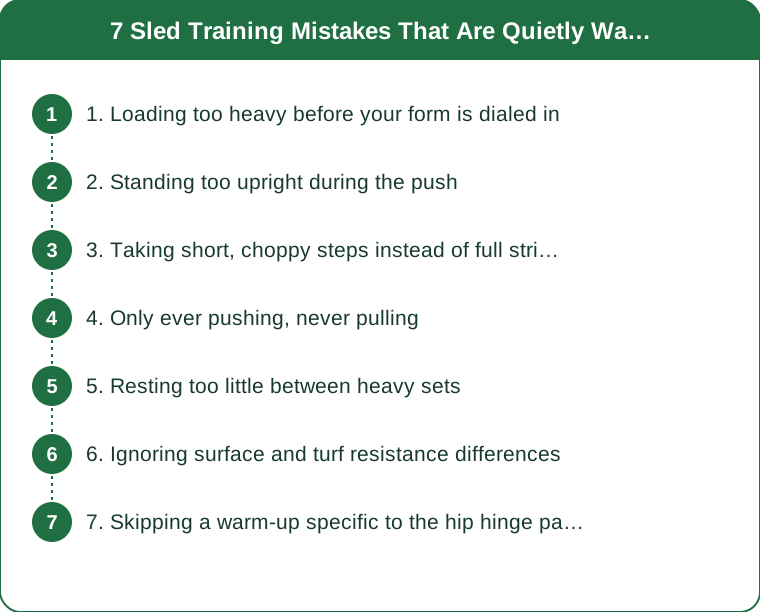
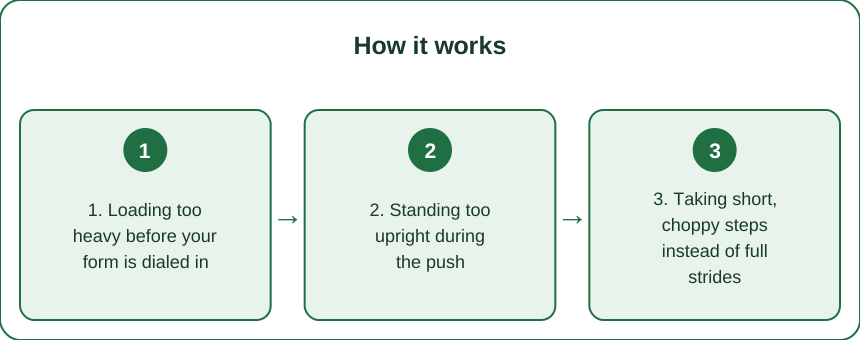
1. Loading too heavy before your form is dialed in
Heavy sled loads with bad form just reinforce the bad form under load, making it harder to correct later. Start light enough that you can maintain a consistent body angle and stride for the full distance — add weight only once that’s automatic, usually after 2-3 sessions.
2. Standing too upright during the push
An upright torso shifts the work away from your glutes and hamstrings and into your quads and lower back, which is both less effective and more likely to cause soreness in the wrong places. Lean forward from the hips at roughly a 45-degree angle, hands extended, driving through your whole foot.
3. Taking short, choppy steps instead of full strides
Short steps under sled resistance reduce hip extension range, which is most of where the glute and hamstring benefit comes from. Focus on longer, more deliberate strides even if it feels slightly less stable at first — the power output improves with practice.

4. Only ever pushing, never pulling
Sled pulls (rope or harness, walking backward or forward) train a completely different movement pattern — more quad and anterior chain dominant — that pure pushing misses. Programs that only push are leaving half the sled’s training value unused.
5. Resting too little between heavy sets
Sled work at genuinely heavy loads is a power and strength exercise, not pure cardio — treating it like a cardio circuit with 20-30 second rests undertrains the strength adaptation. For heavy loads, 60-90 seconds of rest lets you maintain quality across sets.
6. Ignoring surface and turf resistance differences
Turf, concrete, and rubber flooring all create meaningfully different friction, meaning the “same” weight on your sled can feel completely different depending on where you train. Don’t compare your load numbers across gyms without accounting for this.
7. Skipping a warm-up specific to the hip hinge pattern
Sled pushing loads the hip flexors and glutes hard from the first rep. Going straight into heavy pushes without a hip-focused warm-up (leg swings, walking lunges) increases strain risk on muscles that haven’t been primed for the pattern yet.
TL;DR:
- Dial in form at light load before adding weight
- Lean forward ~45 degrees and take full strides — don’t stay upright with short steps
- Include both pushes and pulls for complete lower-body training
- Rest 60-90 seconds between heavy sets, and warm up the hip hinge pattern first
None of these fixes require new equipment — just a few adjustments to how you’re already using the sled.
Keep Reading
This article is for general informational and styling purposes only. Fit, sizing, and product availability may vary.