7 Mistakes That Quietly Strain Your Lower Back During Sled Training
Quick Answer: Lower back strain during sled training most often comes from rounding the spine instead of hinging at the hips, standing too upright during a push, overloading the sled before form is solid, and pulling with the arms and back instead of the legs — correcting body angle and load progression addresses the majority of these issues.
Sled work feels intuitive enough that most people never get a form check on it, which is exactly why these seven mistakes are so common and so quietly cumulative on the lower back.

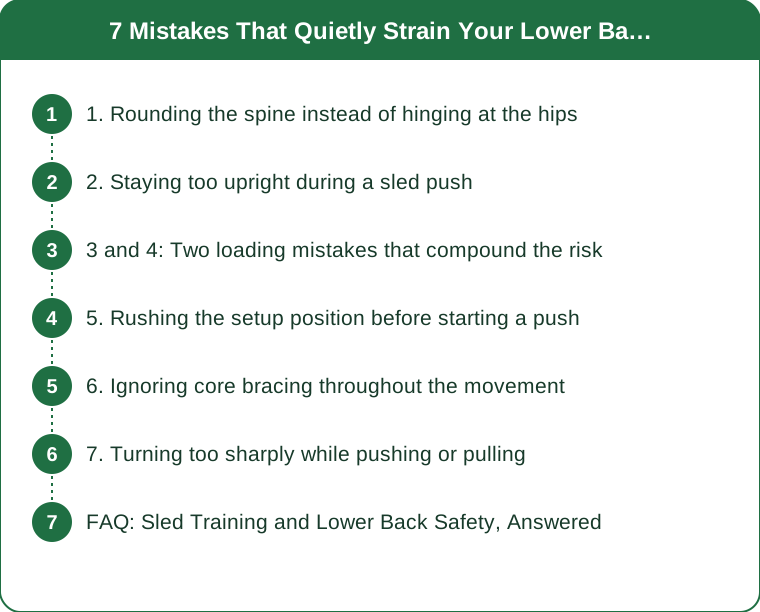
1. Rounding the spine instead of hinging at the hips
A rounded lower back during a sled push or pull shifts load away from the strong hip and glute muscles and onto the spine’s smaller stabilizing muscles and discs, and maintaining a neutral, slightly hinged spine position (similar to a deadlift hinge) keeps the powerful hip muscles doing the work instead, which is both more effective and considerably safer for the lower back over repeated sets.
2. Staying too upright during a sled push
An upright torso during a heavy sled push reduces the ability to drive force forward through the hips and legs, often causing compensation through excessive lower back arching or straining to generate power that should be coming from leg drive, while a more forward-leaning torso angle (proportional to the sled’s load) channels force more efficiently and keeps the back in a safer, more supported position.
3 and 4: Two loading mistakes that compound the risk
3. Adding weight before form is consistently solid
Increasing sled load before movement pattern and body angle are consistently correct under lighter weight means the added resistance amplifies whatever form flaw already exists, turning a minor technique issue into a much higher-risk one under heavier load.
4. Pulling with the arms and back instead of the legs
Sled pulls done primarily with arm and back strength, rather than driving power from the legs and hips through a rope or harness, place unnecessary strain on the lower back and upper body, when the sled pull is fundamentally meant to be a leg-and-hip-dominant exercise similar to a heavy walking lunge or step pattern.

5. Rushing the setup position before starting a push
A quick, careless setup — grabbing the sled handles without establishing a proper hip hinge and foot position first — often locks in poor spine alignment for the entire set, while taking a few extra seconds to set the hip angle and brace the core before the first step meaningfully reduces the risk of the spine compensating once the sled starts moving.
6. Ignoring core bracing throughout the movement
A properly braced core (actively engaging the abdominal muscles, not just holding breath) stabilizes the spine and transfers force more efficiently from the lower body through the torso, and a core that goes slack partway through a set — common as fatigue sets in — is a frequent point where form breaks down and lower back strain risk increases significantly.
7. Turning too sharply while pushing or pulling
Sharp, twisting turns while actively pushing or pulling a loaded sled combine spinal rotation with heavy loading, a combination that’s considerably more likely to strain the lower back than straight-line movement; slowing down and executing wider, more gradual turns, or stopping the sled fully before changing direction, reduces this specific risk.
FAQ: Sled Training and Lower Back Safety, Answered
Is some lower back fatigue normal after sled training, or always a sign of bad form?
Mild, general fatigue that resolves within a day is common and not necessarily concerning, but sharp pain, pain that lingers for several days, or pain during the movement itself are signals worth addressing through a form check rather than pushing through.
Does sled push or sled pull tend to be harder on the lower back?
Both can strain the back if done with poor form, though sled pulls done with excessive arm and back involvement (rather than leg drive) are a particularly common source of back strain specifically.
Is it worth having a trainer check sled form even for an experienced lifter?
Yes — sled work uses somewhat different mechanics than typical barbell lifts, and even experienced lifters can develop unnoticed compensations specific to sled pushing and pulling that are easy to miss without outside feedback.
TL;DR:
- Rounding the spine instead of hinging at the hips shifts load away from strong hip muscles onto the back
- Staying too upright during a push often causes compensatory lower back arching
- Adding weight before form is solid amplifies existing technique flaws under heavier load
- Core bracing and controlled, gradual turns both meaningfully reduce lower back strain risk
This is general information, not medical advice — persistent pain should be evaluated by a professional. Sled training’s simplicity is exactly why these seven mistakes go unnoticed for so long, and fixing body angle and load progression addresses nearly all of them at once.
Keep Reading
This article is for general informational and styling purposes only. Fit, sizing, and product availability may vary.